
2nd Amendment & the Pledge - one of the reasons for this webpage.
U.S. v. Wonschik - a federal court case that involves gun rights and the Pledge of Allegiance in court.
A QUICK SCARY OVERVIEW - about the ideas that inspired the Pledge and caused atrocities worldwide.
This is the only place that collects and shows historic photos of the original socialist salute to the U.S. flag. This is the only place that tells you the WHOLE story, not the "government-school" version. The salute was like the salute of the monstrous National Socialist German Workers' Party.


to learn more see the bottom

to learn more see the bottom
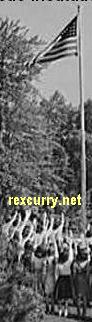
The issue of gun rights and the Pledge of Allegiance are both at issue in a case that is headed for the U.S. Supreme Court. The case is U.S. v Wonschik at http://rexcurry.net/pledge4.html
The Pledge of Allegiance court case is a blessing in disguise, by providing a temporary delay. It allows the fight to widen against the entire Pledge, not just two words. As a libertarian and a lawyer, I am spearheading efforts to expand the litigation as a pro bono service to the public to liberate Americans from government pushing the totalitarian Pledge. http://rexcurry.net/pledge1.html
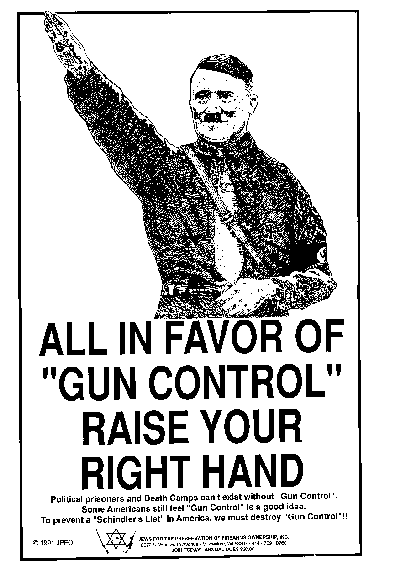
“Pledge II” will be a blockbuster sequel. The first case led to scary discoveries about the Pledge’s pedigree. A libertarian made the historic news-breaking discovery that exposed the Pledge as the origin of the salute of the monstrous National Socialist German Workers’ Party (Nazis). It is a myth that the Pledge’s original straight-arm salute is an ancient Roman salute. http://rexcurry.net/pledgesalute.html
The Pledge was written in 1892 by Francis Bellamy, a self-proclaimed National Socialist in the U.S., who wanted a government takeover of education to produce an "industrial army" for the authoritarian vision portrayed in his cousin Edward Bellamy's book "Looking Backward." The Bellamy cousins promoted national socialism worldwide for decades. Their acts resulted in racist and segregated government schools that lasted into the 1960's.
The pledge is a great issue for advocates of freedom. Americans can change the entire "pledge issue" from a limited debate about two words, to a liberating debate about government, totalitarianism and government schools. http://rexcurry.net/pledge1.html
I am filing another amicus curiae brief in a case that is already exposing the entire Pledge of Allegiance, a case that is more important than Newdow’s case was, though it is virtually unknown: U.S. v. Wonschik, case #03-10249 at the U.S. Supreme Court. http://rexcurry.net/pledge4.html
Wonschik argues that judges should not lead jurors in reciting the Pledge because jurors feel forced to recite the Pledge, and that criminal defendants are denied a fair trial due to the appearance that Judges favor the prosecution. http://rexcurry.net/pledgelaws.html I am also a member of the National Association of Criminal Defense Lawyers, and we have already filed an amicus curiae brief in support of Wonschik on behalf of the NACDL organization.
People ask if the Pledge of Allegiance promotes authoritarianism. Yes it does, not only paying homage to a man who wanted the Pledge used to promote government schools and authoritarianism, who wanted government schools operated as a socialist monopoly, and to end all of the better alternatives, and who wanted government schools used to create an "industrial army" (a Bellamy phrase) modeled after the military, for a socialist economy and society.
Everyone knows that the Bellamy cousins succeeded in many ways, in that most schools are government schools, where the socialist’s pledge is still robotically chanted, and where children and their parents have learned to accept the government school monopoly, social security, socialist slave numbers, gun control, etc.
The pledge is usually recited because it is required by state laws for government schools, and done collectively as a robotic chant daily on cue from the government.
The pledge's history is suppressed because it is so un-libertarian. As strange as it may seem, the ideas that inspired the pledge's author also influenced the Holocaust, and the bigger socialist Wholecaust that occurred under the industrial armies of the socialist trio of atrocities (see http://rexcurry.net/socialists.jpg) in which the Union of Soviet Socialist Republics killed 62 million; the People's Republic of China killed 35 million; and the National Socialist German Workers’ Party killed 21 million. http://rexcurry.net/pledgebackward.html
It is hard to imagine a better issue begging for the correct arguments to be made. Please help make the Pledge of Allegiance debate into a meaningful debate about liberty.
On July 4th, declare your independence from the Pledge of Allegiance. If schoolchildren should recite anything, then they should recite the Declaration of Independence, not the Pledge of Allegiance. They are mutually exclusive and contradictory.
Support individualism, not authoritarianism. If the government’s antidisestablishmentarianism does not end, then we will be living in an even bigger police state. Pledge your independence, and don’t declare your allegiance.
****************
For more comments about gun rights and the Pledge of Allegiance see http://rexcurry.net/pledgehoratii.html
and http://rexcurry.net/guncom.html
Tom Brokaw, anchor and managing editor of the top-rated "NBC Nightly News," and Rex Curry, lawyer and libertarian commentator, were the first and only journalists honored for exposing the "National Socialist German Workers' Party" to the public in Google News' search engine on D-Day of 2004. On that date, June 6, 2004, and for 30 days or more thereafter Google News showed only Brokaw's and Curry's use of the full phrase in Google News archives. Google News selects from 4,500 news sources updated continuously. http://rexcurry.net/google.html
RexCurry.net is the only website that provides the scary original speech given by Francis Bellamy for the debut of his Pledge of Allegiance. http://rexcurry.net/pledgespeech.html
RexCurry.net is the only website that collects and displays true historic photographs of the original Pledge of Allegiance (with the straight-arm salute). http://rexcurry.net/pledge1.html that site is provided as an educational service to the public even though RexCurry.net is not even a mainstream news media site.
Fan mail praising the expose’ of the totalitarian Pledge of Allegiance is at
http://rexcurry.net/pledge_heart.html
*****************
Some law students are writing an amicus brief to the court and the students are trying to find out how many judges in the U.S. make the courtroom audience and jurors to say the Pledge of Allegiance. The criminal charge in the case has no allegation of violence and is a classic example of how the federal government is taking over criminal prosecutions from states and doing so by manufacturing jurisdiction with charges that do not address any actual act(s) of violence, nor any acts that are the actual origin of the case, but do so by criminalizing non-violent aspects in ways that arguably violate the 2nd amendment and the right to keep and bear arms, instead of leaving the state to pursue the intelligent charges involving any actual violence. The federal criminal charge in the case involves the non-violent act of possession of gun parts.
Here is the message from the students who are doing the amicus brief: Thank you for speaking with me the other day concerning an amicus brief that myself and another student will be filing with the United States Supreme Court. A federal district judge made the court room, including potential jurors recite the "Pledge of Allegiance" prior to the start of the trial. We want to find out how prevalent this practice is. The question that we would like posted is as follows:
1) Are you aware of any instances where a judge made the courtroom recite
the "Pledge of Allegiance" in the courtroom, particularly in criminal cases?
a) If yes, how often did that occur?
b) What court? What judge if known?
c) At what point in the proceedings?
d) Was the jury present? Did the jury have to participate?
Because the original post was to a specific list, I have not repeated the student's emails, however I will be happy to forward responses to the students (email responses to rexy@ij.net ) regarding the Pledge of Allegiance in courtrooms elsewhere.
My response to the students was: I enjoyed your note re: the judge who makes everyone pledge allegiance in court. It would be great if you could attach photographs of the original pledge of allegiance to your brief. see http://rexcurry.net/pledge4.html as well as filling your brief and arguments with the terrifying origins and history of the pledge.
By the way, remember that jurors today are mostly from government schools, and that means that not only have they been robotically chanting the pledge en masse and on cue from the government daily for their entire education, worse still, they were educated by the government (and that was not originally the case in this country, and education/schools are no where mentioned in the constitution, and in fact government was taking over education at the same time that the Pledge was created, and that is one of the purposes of the original Pledge of Allegiance celebration as described at http://rexcurry.net/pledge4.html ). Therefore, all of your arguments against the Pledge in court are even more compelling for objecting to government schools and to jurors from government schools. Afterall, we know that jurors were taught by government in government schools that they are required to render verdicts of guilty based on evidence in cases where they should always render verdicts of acquittal (drugs, medical marijuana, vices, prostitution, gambling, gun possession, and all non-violent consensual activity that is criminalized) - cases that should not involve criminal charges at all. A Pledge of Allegiance in a courtroom is just reaffirming what the government has already taught the jurors in
government schools.
Here is an amusing response from a lawyer: "We had a D.C. Superior Court judge who used to do this every morning. All the criminal defense lawyers (well, all two or three who were in the courtroom at 9:01 am) would mumble "Objection" and sit there during the pledge. I mean, pledging allegiance to the flag of the United States was almost like pledging allegiance to the U.S. Attorney at that table over there. It was a running gag. The Judge was also the only criminal division judge I ever saw who would start the day standing with his back to the courtroom. Seems to me those old Marines often got more guts than brains."
UNITED STATES OF AMERICA, Plaintiff-Appellee, v. FRANK HERBERT WONSCHIK, JR., Defendant-Appellant.
No. 02-1276
UNITED STATES COURT OF APPEALS FOR THE TENTH CIRCUIT
January 6, 2004, Filed
PRIOR HISTORY: [*1] APPEAL FROM THE UNITED STATES DISTRICT COURT FOR THE DISTRICT OF COLORADO. (D.C. NO. 01-CR-410).
DISPOSITION: Affirmed.
COUNSEL: Jill M. Wichlens, Assistant Federal Public Defender, (Michael G. Katz, Federal Public Defender, with her on the brief) Denver, Colorado for Defendant-Appellant.
Robert M. Russel, Assistant United States Attorney, (John W. Suthers, United States Attorney, with him on the brief), Denver, Colorado for Plaintiff-Appellee.
JUDGES: Before MURPHY, BRORBY, and McCONNELL, Circuit Judges.
OPINIONBY: McCONNELL
OPINION: McCONNELL, Circuit Judge.
In this appeal, we consider (1) whether a jury instruction that defined "machinegun" as that term is defined in § 5845(b) of the National Firearms Act (26 U.S.C. § 5845(b)) constructively amended a defendant's indictment for possessing "parts from which a machine gun could be assembled," and (2) whether a district judge's leading jurors in reciting the Pledge of Allegiance during voir dire violated a defendant's right to a fair trial. We answer both questions in the negative and, therefore, AFFIRM the judgment of the district court.
I.
On the evening of November 19, 1999, Appellant Frank Herbert Wonschik, Jr. [*2] was home alone at his house in a suburban neighborhood in Aurora, Colorado. That night became memorable for Mr. Wonschik's neighbors when they heard gunshots coming from inside Mr. Wonschik's house and noticed bullets passing through the walls of their own house. The neighbors immediately summoned the police, who arrived outside Mr. Wonschik's house at about 7:00 p.m.
Mr. Wonschik staggered down his driveway to meet the police. He was obviously drunk. He held up a large, M-80 style firecracker and a lighter and asked the police, "Did you hear that loud bang?" Tr. 208. The officers, for safety reasons, placed Mr. Wonschik in the back of a patrol car. Although the officers asked him no questions, Mr. Wonschik began a bizarre soliloquy. He stated that he had received death threats, that Colombian drug lords were watching him, that one of his neighbors was out to get him, that he was a millionaire who spent $ 500,000 a year on lawyers, and that he had no idea how the holes in his wall got there.
The police promptly obtained a search warrant and entered Mr. Wonschik's house. On the wall in the main room downstairs, the police observed a poster of a wolf with bullet holes in it and several [*3] spent 10-millimeter casings nearby. It was evident that Mr. Wonschik, in his inebriated condition, had fired several rounds from a 10-millimeter pistol into the wolf and that those rounds had passed through Mr. Wonschik's walls and prompted the neighbors to call the police.
The officers also discovered, on a table in the same room, a partially disassembled Colt AR-15 rifle, which is the civilian, semiautomatic version of the military's M-16 automatic rifle. n1 The police also found many boxes of 5.56 millimeter ammunition for the AR-15, as well as a coffee can full of spent 5.56 casings. The officers then searched a bedroom upstairs, where they found, in a filing cabinet, a bag containing several small gun parts. The police determined that the parts were apparently the components necessary to convert a semiautomatic AR-15 into a fully automatic M-16, including an M-16 bolt carrier, M-16 hammers, an M-16A2 trigger, M-16 disconnectors, disconnector springs, a selector switch, a three-shot burst cam, and two drop-in auto sears. Finally, the police discovered, in a different bedroom, an instruction manual that explained how to convert a semiautomatic AR-15 into a fully automatic weapon. [*4] The manual warned that it was illegal to possess M-16 parts.
- - - - - - - - - - - - - - Footnotes - - - - - - - - - - - - - - -
n1 The Colt AR-15 is also known as the Colt Model SP-1, which is how Mr. Wonschik's rifle is designated in the indictment. The indictment describes the weapon as ".223 caliber," which is equivalent to 5.56 millimeter. R. doc. 1.
- - - - - - - - - - - - End Footnotes- - - - - - - - - - - - - -
Mr. Wonschik was eventually indicted by a federal grand jury on one count of illegal possession of a machine gun in violation of 18 U.S.C. § 922(o). The grand jury specifically charged Mr. Wonschik with possessing "a combination of parts . . . from which a machine gun could be assembled." R. doc. 1. At trial, a government expert witness testified that he installed some of the M-16 parts found in the filing cabinet into Mr. Wonschik's AR-15. The expert explained that he was unable to make the weapon function with either of the drop-in auto sears installed, so he tested the modified AR-15 without an auto sear. n2 He told the jury that he twice loaded the modified weapon with two rounds and that both times [*5] the weapon fired automatically, meaning that both rounds fired with one pull of the trigger. On cross-examination, the government expert stated that he did not know whether the modified AR-15 would successfully fire automatically until he tested it.
- - - - - - - - - - - - - - Footnotes - - - - - - - - - - - - - - -
n2 In an M-16, the "auto sear" facilitates proper timing of automatic firing by catching the hammer when the bolt carrier forces it back after firing and then releasing the hammer after the bolt carrier has moved forward in preparation for the next cycle. Tr. 357. A "drop-in" auto sear replicates the function of an M-16 sear in an AR-15 that has been converted into an automatic weapon by the addition of M-16 fire control parts. Tr. 309. An auto sear can, by itself, constitute a "machinegun" under the National Firearms Act. United States v. Cash, 149 F.3d 706, 706-08 (7th Cir. 1998).
- - - - - - - - - - - - End Footnotes- - - - - - - - - - - - - -
Mr. Wonschik's defense was that his weapon, as assembled by the government expert, was not "automatic," and therefore not a machine gun, and that the government could [*6] not prove that he knew that his combination of parts could be assembled into a functioning machine gun. In support of this theory, Mr. Wonschik put his own expert witness on the stand. The defense expert testified that Mr. Wonschik's AR-15, as modified by the government expert, did not qualify as an automatic weapon. Because the modified weapon did not contain an auto sear, which the defense expert characterized as "an integral part of the fire control system," Tr. 380, the government expert was only able to get Mr. Wonschik's rifle to fire automatically by inducing a malfunction. Mr. Wonschik's expert also testified that he would not know whether a weapon modified in this way would actually fire automatically without testing it.
Defense counsel moved for a judgment of acquittal on the ground that the government had provided insufficient evidence that he knew that his parts could be assembled into a machine gun. The district court denied the motion and submitted the case to the jury. The jury was instructed that the government must prove that the defendant knew that the relevant parts constituted "a combination of parts from which a machine gun can be assembled." R. doc. 42, Instruction [*7] 12. The instructions defined "machine gun" to include "any weapon which shoots, is designed to shoot, or can be readily restored to shoot, automatically." Id. The jury convicted Mr. Wonschik of the one-count indictment. The district judge subsequently sentenced Mr. Wonschik to 27 months' imprisonment.
The morning before Mr. Wonschik's trial began, the parties and the district judge gathered in the courtroom before a panel of 47 potential jurors in order to conduct voir dire. The judge introduced himself to the panel, and then began speaking to the panel about the events of September 11 and the obligations of American citizens. He referred to a young family friend in the Marines who was deployed to the Middle East, and then said:
This kid is off to fight a war for us. The least we can do is to uphold what he holds sacred. He pledged an oath to support and defend the United States against all its enemies; and he expect us, you and me, to uphold the Constitution of the United States. And that's what we're going to do in this room today. And you people, citizens of the United States, are going to bring life to the Constitution. The Constitution is nothing but a shriveled piece [*8] of paper unless people like you breathe life into it.
I didn't do it before September 11, the Pledge of Allegiance, in the morning we begin a trial. It isn't that I didn't put stock in it. Of course, I did. But I just didn't think it needed to intrude on the business of the Court every time we pick a jury trial. I was wrong. Each of us, me included, on an occasion of this importance, needs to remind ourselves of our obligation to our country.
Would you join me now in the Pledge of Allegiance.Tr. 16. The judge and jurors then apparently recited the Pledge of Allegiance as it is codified in 4 U.S.C. § 4: "I pledge allegiance to the Flag of the United States of America, and to the Republic for which it stands, one Nation under God, indivisible, with liberty and justice for all."
On appeal, Mr. Wonschik contends that his conviction must be overturned because (1) the jury instructions effectively amended the indictment; and (2) the trial judge's leading the Pledge of Allegiance during voir dire deprived him of a fair trial.
II.
The jury convicted Mr. Wonschik of a violation of 18 U.S.C. § 922(o), which makes it unlawful "for any [*9] person to transfer or possess a machinegun." The related definition section refers to the definition of "machinegun" provided in § 5845(b) of the National Firearms Act. 18 U.S.C. § 921(a)(23). The National Firearms Act in turn provides the following definition:(b) Machinegun. The term "machinegun" means any weapon which shoots, is designed to shoot, or can be readily restored to shoot, automatically more than one shot, without manual reloading, by a single function of the trigger. The term shall also include the frame or receiver of any such weapon, any part designed and intended solely and exclusively, or combination of parts designed and intended, for use in converting a weapon into a machinegun, and any combination of parts from which a machinegun can be assembled if such parts are in the possession or under the control of a person.26 U.S.C. § 5845(b).
The indictment closely follows this statutory language. The grand jury alleged that Mr. Wonschik
did unlawfully and knowingly possess a machine gun, to wit: a combination of parts, in the possession and control of FRANK HERBERT WONSCHIK, Jr., namely: a [*10] Colt, Model SP1, .223 caliber, semi-automatic rifle, an M16 selector, an M16 bolt carrier, M16 hammers, M16A2 trigger, M16 disconnectors, disconnector springs, and a three shot burst cam, from which a machine gun could be assembled . . . .R. doc. 1.
Finally, Jury Instruction 12, which Mr. Wonschik claims impermissibly broadened the indictment, also tracks the statutory language:
In order to convict the defendant . . ., the government must prove each of the following elements beyond a reasonable doubt:
First: That the defendant knowingly possessed a machine gun; and
Second: That the defendant knew that the Colt, Model SP1, .223 caliber, semi automatic rifle; and M16 bolt carrier, M16 hammers, M16A2 trigger, M16 disconnectors, disconnectors [sic] springs, and a three shot burst cam, was a combination of parts from which a machine gun can be assembled.
As used in this instruction, the term "machine gun" includes any weapon which shoots, is designed to shoot, or can be readily restored to shoot, automatically more than one shot without manual reloading, by a single function of the trigger. The term "machine gun" also includes any combination of parts from which [*11] a machine gun can be assembled if such parts are in the possession or under the control of a person.R. doc. 42.
Mr. Wonschik and the government both agree that the statute prohibits possession of a "combination of parts from which a machinegun can be assembled" and that the indictment charged Mr. Wonschik with possession of such parts. The dispute is over how to define the term "machinegun" as it refers to the result of assembling the parts. Specifically, Mr. Wonschik contends that "machinegun" here means a gun actually capable of firing automatically. His position is therefore that, under the indictment, the government was required to prove that he knowingly possessed a combination of parts from which a functioning automatic weapon could be assembled. Instruction 12, however, defined "machinegun" more broadly to include weapons "designed to shoot" automatically, as well as weapons that actually shoot automatically. Thus, according to the instruction, the jury did not have to find that Mr. Wonschik's parts could be assembled into a functioning automatic weapon, because the instruction allowed conviction on the basis that his parts could be assembled into a weapon that was [*12] merely "designed" to shoot automatically.
The government apparently agrees that the instruction allowed conviction on that basis. However, according to the government, the instruction did not impermissibly broaden the indictment because the instruction's interpretation of "machinegun" to include weapons designed to shoot automatically is perfectly consistent with how "machinegun" is defined in § 5845(b). Because the indictment tracks that same statutory language, it is reasonable, in the government's view, to interpret the term "machinegun" in the indictment as referring to weapons designed to shoot automatically, as well as to actually functioning automatic weapons.
Mr. Wonschik's trial counsel did not object to Instruction 12. We therefore review his constructive amendment claim for plain error. United States v. Cavely, 318 F.3d 987, 999 (10th Cir. 2003). n3 When trial counsel fails to object, the appellate court will liberally construe the indictment in favor of validity. United States v. Phillips, 869 F.2d 1361, 1364-65 (10th Cir. 1988). We will only find that a constructive amendment occurred when "the evidence presented at trial, together [*13] with the jury instructions, raises the possibility that the defendant was convicted of an offense other than that charged in the indictment." United States v. Apodaca, 843 F.2d 421, 428 (10th Cir. 1988) (citing Stirone v. United States, 361 U.S. 212, 215-19, 4 L. Ed. 2d 252, 80 S. Ct. 270 (1960)).
- - - - - - - - - - - - - - Footnotes - - - - - - - - - - - - - - -
n3 There is some uncertainty in our precedents as to whether a constructive amendment of an indictment by jury instructions to which the defendant did not object is reversible per se or reversible only where the amendment "affects substantial rights" and "seriously affects the fairness, integrity or public reputation of judicial proceedings." Compare United States v. Levine, 41 F.3d 607, 617 n.13 (10th Cir. 1994) with Cavely, 318 F.3d at 999. Because we conclude that no constructive amendment occurred here, we need not resolve this question.
- - - - - - - - - - - - End Footnotes- - - - - - - - - - - - - -
We are not persuaded that Mr. Wonschik's interpretation of § 5845(b) and the corresponding language in the indictment is correct. [*14] One serious problem with Mr. Wonschik's reading is that it would result in giving the term "machinegun" two separate meanings within the same subsection of the National Firearms Act. Mr. Wonschik contends that the term "machinegun" in the phrase "parts from which a machinegun can be assembled" should mean something like "a weapon that actually fires automatically," even though the first sentence of the same subsection expressly states that "the term 'machinegun' means any weapon which shoots, is designed to shoot, or can be readily restored to shoot, automatically." 26 U.S.C. § 5845(b) (emphasis added). Where, as here, a statute begins with a sentence stating what a term "means," and then repeats that term later in the same subsection, it seems reasonable to give the later-appearing term the same meaning that it was given in the first sentence. Cf. Estate of Cowart v. Nicklos Drilling Co., 505 U.S. 469, 479, 120 L. Ed. 2d 379, 112 S. Ct. 2589 (1992) (referring to the basic canon of statutory construction that a term or phrase should generally be given the same meaning each time it appears in the same act). Mr. Wonschik has provided no authority supporting [*15] his claim that "machinegun" should mean less at the end of the paragraph than it does at the beginning.
There does appear to be a confusing circularity to the treatment of "machinegun" in § 5845(b). The statute offers a definition of machinegun as "any weapon which shoots, is designed to shoot, or can be readily restored to shoot, automatically," and then goes on to state that "the term shall also include" the frame or receiver of a machinegun, parts designed and intended to convert a weapon into a machinegun, and parts from which a machinegun can be assembled. Thus, the statute seems circularly to say that a "machinegun" is, among other things, a "receiver of a machinegun" or "parts that can be made into a machinegun." However, any resulting confusion can be resolved through close attention to the subsection's grammatical structure. Subsection (b), as noted above, provides a primary definition of the term "machinegun" and then sets apart this primary definition with a period. A new sentence then states that the "term shall also include" receivers or parts bearing some relation to a "machinegun." This structure suggests that, where "machinegun" or "such weapon" appears in the second [*16] part of the subsection, as an attribute of receivers or parts, the statute implicitly substitutes in the primary definition of "machinegun" provided in the first sentence. This reading provides a consistent definition for "machinegun" and "such weapon" (namely, "any weapon which shoots, is designed to shoot, or can be readily restored to shoot, automatically more than one shot, without manual reloading, by a single function of the trigger") each time these terms appear within the subsection. Thus, the phrase "a combination of parts from which a machinegun can be assembled" actually means "a combination of parts from which [any weapon which shoots, is designed to shoot, or can be readily restored to shoot, automatically more than one shot, without manual reloading, by a single function of the trigger] can be assembled." This is precisely the definition set forth in Instruction 12. It follows that the instruction did not amend the indictment, but instead correctly tracked the statutory definition on which the indictment was based.
III.
Although Mr. Wonschik's trial counsel did not object to the jurors' recitation of the Pledge of Allegiance, he now contends on appeal that the district [*17] judge violated the Constitution. Mr. Wonschik argues that the district judge's action was unconstitutional under West Virginia State Board of Education v. Barnette, 319 U.S. 624, 87 L. Ed. 1628, 63 S. Ct. 1178 (1943), in which the Supreme Court held that a state board of education could not compel its students to recite the Pledge of Allegiance. However, the question whether recitation of the pledge in this context violates Barnette is irrelevant, because Mr. Wonschik does not claim that he was compelled or invited to recite the pledge, and he does not have third-party standing to raise claims on behalf of the potential jurors. See Terrell v. INS, 157 F.3d 806, 809 (10th Cir. 1998).
Mr. Wonschik's more serious argument is that jurors' recitation of the pledge, in a case where the United States is a party, violates the other party's right to a fair trial because the jury is in effect pledging its allegiance to one party in the case. Mr. Wonschik contends that the jury was particularly likely to draw this inference in his case because immediately following recitation of the pledge, the district judge addressed the prosecutor and asked whether "the United States [*18] of America" was ready to proceed. Tr. 16.
We recognize that trial judges, among their many other responsibilities, should take care not to create the impression that it is appropriate for the judge or the jury to favor the prosecution simply because the court and the prosecution are both institutions of the United States. However, we do not think it reasonable to suppose that the jurors inferred from the Pledge of Allegiance a patriotic obligation to serve as a rubber stamp for the prosecution. Rather, we believe the pledge represents, and evoked in the jurors' minds, a more enlightened patriotism, fidelity to which required them to uphold our nation's Constitution and laws by sitting as impartial finders of fact in the matter before them. That is as likely to benefit a defendant as to prejudice him.
IV.
For the foregoing reasons, the judgment of the district court is AFFIRMED. All pending motions are denied.
The issue of gun rights and the Pledge of Allegiance are both at issue in a case that is headed for the U.S. Supreme Court. The case is U.S. v Wonschik at http://rexcurry.net/pledge4.html
The Pledge of Allegiance court case is a blessing in disguise, by providing a temporary delay. It allows the fight to widen against the entire Pledge, not just two words. As a libertarian and a lawyer, I am spearheading efforts to expand the litigation as a pro bono service to the public to liberate Americans from government pushing the totalitarian Pledge. http://rexcurry.net/pledge1.html
“Pledge II” will be a blockbuster sequel. The first case led to scary discoveries about the Pledge’s pedigree. A libertarian made the historic news-breaking discovery that exposed the Pledge as the origin of the salute of the monstrous National Socialist German Workers’ Party (Nazis). It is a myth that the Pledge’s original straight-arm salute is an ancient Roman salute. http://rexcurry.net/pledgesalute.html
The Pledge was written in 1892 by Francis Bellamy, a self-proclaimed National Socialist in the U.S., who wanted a government takeover of education to produce an "industrial army" for the authoritarian vision portrayed in his cousin Edward Bellamy's book "Looking Backward." The Bellamy cousins promoted national socialism worldwide for decades. Their acts resulted in racist and segregated government schools that lasted into the 1960's.
The pledge is a great issue for advocates of freedom. Americans can change the entire "pledge issue" from a limited debate about two words, to a liberating debate about government, totalitarianism and government schools. http://rexcurry.net/pledge1.html
I am filing another amicus curiae brief in a case that is already exposing the entire Pledge of Allegiance, a case that is more important than Newdow’s case was, though it is virtually unknown: U.S. v. Wonschik, case #03-10249 at the U.S. Supreme Court. http://rexcurry.net/pledge4.html
Wonschik argues that judges should not lead jurors in reciting the Pledge because jurors feel forced to recite the Pledge, and that criminal defendants are denied a fair trial due to the appearance that Judges favor the prosecution. http://rexcurry.net/pledgelaws.html I am also a member of the National Association of Criminal Defense Lawyers, and we have already filed an amicus curiae brief in support of Wonschik on behalf of the NACDL organization.
People ask if the Pledge of Allegiance promotes authoritarianism. Yes it does, not only paying homage to a man who wanted the Pledge used to promote government schools and authoritarianism, who wanted government schools operated as a socialist monopoly, and to end all of the better alternatives, and who wanted government schools used to create an "industrial army" (a Bellamy phrase) modeled after the military, for a socialist economy and society.
Everyone knows that the Bellamy cousins succeeded in many ways, in that most schools are government schools, where the socialist’s pledge is still robotically chanted, and where children and their parents have learned to accept the government school monopoly, social security, socialist slave numbers, gun control, etc.
The pledge is usually recited because it is required by state laws for government schools, and done collectively as a robotic chant daily on cue from the government.
The pledge's history is suppressed because it is so un-libertarian. As strange as it may seem, the ideas that inspired the pledge's author also influenced the Holocaust, and the bigger socialist Wholecaust that occurred under the industrial armies of the socialist trio of atrocities (see http://rexcurry.net/socialists.jpg) in which the Union of Soviet Socialist Republics killed 62 million; the People's Republic of China killed 35 million; and the National Socialist German Workers’ Party killed 21 million. http://rexcurry.net/pledgebackward.html
It is hard to imagine a better issue begging for the correct arguments to be made. Please help make the Pledge of Allegiance debate into a meaningful debate about liberty.
On July 4th, declare your independence from the Pledge of Allegiance. If schoolchildren should recite anything, then they should recite the Declaration of Independence, not the Pledge of Allegiance. They are mutually exclusive and contradictory.
Support individualism, not authoritarianism. If the government’s antidisestablishmentarianism does not end, then we will be living in an even bigger police state. Pledge your independence, and don’t declare your allegiance.
****************
For more comments about gun rights and the Pledge of Allegiance see http://rexcurry.net/pledgehoratii.html
and http://rexcurry.net/guncom.html
Tom Brokaw, anchor and managing editor of the top-rated "NBC Nightly News," and Rex Curry, lawyer and libertarian commentator, were the first and only journalists honored for exposing the "National Socialist German Workers' Party" to the public in Google News' search engine on D-Day of 2004. On that date, June 6, 2004, and for 30 days or more thereafter Google News showed only Brokaw's and Curry's use of the full phrase in Google News archives. Google News selects from 4,500 news sources updated continuously. http://rexcurry.net/google.html
RexCurry.net is the only website that provides the scary original speech given by Francis Bellamy for the debut of his Pledge of Allegiance. http://rexcurry.net/pledgespeech.html
RexCurry.net is the only website that collects and displays true historic photographs of the original Pledge of Allegiance (with the straight-arm salute). http://rexcurry.net/pledge1.html that site is provided as an educational service to the public even though RexCurry.net is not even a mainstream news media site.
Fan mail praising the expose’ of the totalitarian Pledge of Allegiance is at
http://rexcurry.net/pledge_heart.html
*****************
Some law students are writing an amicus brief to the court and the students are trying to find out how many judges in the U.S. make the courtroom audience and jurors to say the Pledge of Allegiance. The criminal charge in the case has no allegation of violence and is a classic example of how the federal government is taking over criminal prosecutions from states and doing so by manufacturing jurisdiction with charges that do not address any actual act(s) of violence, nor any acts that are the actual origin of the case, but do so by criminalizing non-violent aspects in ways that arguably violate the 2nd amendment and the right to keep and bear arms, instead of leaving the state to pursue the intelligent charges involving any actual violence. The federal criminal charge in the case involves the non-violent act of possession of gun parts.
Here is the message from the students who are doing the amicus brief: Thank you for speaking with me the other day concerning an amicus brief that myself and another student will be filing with the United States Supreme Court. A federal district judge made the court room, including potential jurors recite the "Pledge of Allegiance" prior to the start of the trial. We want to find out how prevalent this practice is. The question that we would like posted is as follows:
1) Are you aware of any instances where a judge made the courtroom recite
the "Pledge of Allegiance" in the courtroom, particularly in criminal cases?
a) If yes, how often did that occur?
b) What court? What judge if known?
c) At what point in the proceedings?
d) Was the jury present? Did the jury have to participate?
Because the original post was to a specific list, I have not repeated the student's emails, however I will be happy to forward responses to the students (email responses to rexy@ij.net ) regarding the Pledge of Allegiance in courtrooms elsewhere.
My response to the students was: I enjoyed your note re: the judge who makes everyone pledge allegiance in court. It would be great if you could attach photographs of the original pledge of allegiance to your brief. see http://rexcurry.net/pledge4.html as well as filling your brief and arguments with the terrifying origins and history of the pledge.
By the way, remember that jurors today are mostly from government schools, and that means that not only have they been robotically chanting the pledge en masse and on cue from the government daily for their entire education, worse still, they were educated by the government (and that was not originally the case in this country, and education/schools are no where mentioned in the constitution, and in fact government was taking over education at the same time that the Pledge was created, and that is one of the purposes of the original Pledge of Allegiance celebration as described at http://rexcurry.net/pledge4.html ). Therefore, all of your arguments against the Pledge in court are even more compelling for objecting to government schools and to jurors from government schools. Afterall, we know that jurors were taught by government in government schools that they are required to render verdicts of guilty based on evidence in cases where they should always render verdicts of acquittal (drugs, medical marijuana, vices, prostitution, gambling, gun possession, and all non-violent consensual activity that is criminalized) - cases that should not involve criminal charges at all. A Pledge of Allegiance in a courtroom is just reaffirming what the government has already taught the jurors in
government schools.
Here is an amusing response from a lawyer: "We had a D.C. Superior Court judge who used to do this every morning. All the criminal defense lawyers (well, all two or three who were in the courtroom at 9:01 am) would mumble "Objection" and sit there during the pledge. I mean, pledging allegiance to the flag of the United States was almost like pledging allegiance to the U.S. Attorney at that table over there. It was a running gag. The Judge was also the only criminal division judge I ever saw who would start the day standing with his back to the courtroom. Seems to me those old Marines often got more guts than brains."
*******************************************************
UNITED STATES OF AMERICA, Plaintiff-Appellee, v. FRANK HERBERT WONSCHIK, JR., Defendant-Appellant.
No. 02-1276
UNITED STATES COURT OF APPEALS FOR THE TENTH CIRCUIT
January 6, 2004, Filed
PRIOR HISTORY: [*1] APPEAL FROM THE UNITED STATES DISTRICT COURT FOR THE DISTRICT OF COLORADO. (D.C. NO. 01-CR-410).
DISPOSITION: Affirmed.
COUNSEL: Jill M. Wichlens, Assistant Federal Public Defender, (Michael G. Katz, Federal Public Defender, with her on the brief) Denver, Colorado for Defendant-Appellant.
Robert M. Russel, Assistant United States Attorney, (John W. Suthers, United States Attorney, with him on the brief), Denver, Colorado for Plaintiff-Appellee.
JUDGES: Before MURPHY, BRORBY, and McCONNELL, Circuit Judges.
OPINIONBY: McCONNELL
OPINION: McCONNELL, Circuit Judge.
In this appeal, we consider (1) whether a jury instruction that defined "machinegun" as that term is defined in § 5845(b) of the National Firearms Act (26 U.S.C. § 5845(b)) constructively amended a defendant's indictment for possessing "parts from which a machine gun could be assembled," and (2) whether a district judge's leading jurors in reciting the Pledge of Allegiance during voir dire violated a defendant's right to a fair trial. We answer both questions in the negative and, therefore, AFFIRM the judgment of the district court.
I.
On the evening of November 19, 1999, Appellant Frank Herbert Wonschik, Jr. [*2] was home alone at his house in a suburban neighborhood in Aurora, Colorado. That night became memorable for Mr. Wonschik's neighbors when they heard gunshots coming from inside Mr. Wonschik's house and noticed bullets passing through the walls of their own house. The neighbors immediately summoned the police, who arrived outside Mr. Wonschik's house at about 7:00 p.m.
Mr. Wonschik staggered down his driveway to meet the police. He was obviously drunk. He held up a large, M-80 style firecracker and a lighter and asked the police, "Did you hear that loud bang?" Tr. 208. The officers, for safety reasons, placed Mr. Wonschik in the back of a patrol car. Although the officers asked him no questions, Mr. Wonschik began a bizarre soliloquy. He stated that he had received death threats, that Colombian drug lords were watching him, that one of his neighbors was out to get him, that he was a millionaire who spent $ 500,000 a year on lawyers, and that he had no idea how the holes in his wall got there.
The police promptly obtained a search warrant and entered Mr. Wonschik's house. On the wall in the main room downstairs, the police observed a poster of a wolf with bullet holes in it and several [*3] spent 10-millimeter casings nearby. It was evident that Mr. Wonschik, in his inebriated condition, had fired several rounds from a 10-millimeter pistol into the wolf and that those rounds had passed through Mr. Wonschik's walls and prompted the neighbors to call the police.
The officers also discovered, on a table in the same room, a partially disassembled Colt AR-15 rifle, which is the civilian, semiautomatic version of the military's M-16 automatic rifle. n1 The police also found many boxes of 5.56 millimeter ammunition for the AR-15, as well as a coffee can full of spent 5.56 casings. The officers then searched a bedroom upstairs, where they found, in a filing cabinet, a bag containing several small gun parts. The police determined that the parts were apparently the components necessary to convert a semiautomatic AR-15 into a fully automatic M-16, including an M-16 bolt carrier, M-16 hammers, an M-16A2 trigger, M-16 disconnectors, disconnector springs, a selector switch, a three-shot burst cam, and two drop-in auto sears. Finally, the police discovered, in a different bedroom, an instruction manual that explained how to convert a semiautomatic AR-15 into a fully automatic weapon. [*4] The manual warned that it was illegal to possess M-16 parts.
- - - - - - - - - - - - - - Footnotes - - - - - - - - - - - - - - -
n1 The Colt AR-15 is also known as the Colt Model SP-1, which is how Mr. Wonschik's rifle is designated in the indictment. The indictment describes the weapon as ".223 caliber," which is equivalent to 5.56 millimeter. R. doc. 1.
- - - - - - - - - - - - End Footnotes- - - - - - - - - - - - - -
Mr. Wonschik was eventually indicted by a federal grand jury on one count of illegal possession of a machine gun in violation of 18 U.S.C. § 922(o). The grand jury specifically charged Mr. Wonschik with possessing "a combination of parts . . . from which a machine gun could be assembled." R. doc. 1. At trial, a government expert witness testified that he installed some of the M-16 parts found in the filing cabinet into Mr. Wonschik's AR-15. The expert explained that he was unable to make the weapon function with either of the drop-in auto sears installed, so he tested the modified AR-15 without an auto sear. n2 He told the jury that he twice loaded the modified weapon with two rounds and that both times [*5] the weapon fired automatically, meaning that both rounds fired with one pull of the trigger. On cross-examination, the government expert stated that he did not know whether the modified AR-15 would successfully fire automatically until he tested it.
- - - - - - - - - - - - - - Footnotes - - - - - - - - - - - - - - -
n2 In an M-16, the "auto sear" facilitates proper timing of automatic firing by catching the hammer when the bolt carrier forces it back after firing and then releasing the hammer after the bolt carrier has moved forward in preparation for the next cycle. Tr. 357. A "drop-in" auto sear replicates the function of an M-16 sear in an AR-15 that has been converted into an automatic weapon by the addition of M-16 fire control parts. Tr. 309. An auto sear can, by itself, constitute a "machinegun" under the National Firearms Act. United States v. Cash, 149 F.3d 706, 706-08 (7th Cir. 1998).
- - - - - - - - - - - - End Footnotes- - - - - - - - - - - - - -
Mr. Wonschik's defense was that his weapon, as assembled by the government expert, was not "automatic," and therefore not a machine gun, and that the government could [*6] not prove that he knew that his combination of parts could be assembled into a functioning machine gun. In support of this theory, Mr. Wonschik put his own expert witness on the stand. The defense expert testified that Mr. Wonschik's AR-15, as modified by the government expert, did not qualify as an automatic weapon. Because the modified weapon did not contain an auto sear, which the defense expert characterized as "an integral part of the fire control system," Tr. 380, the government expert was only able to get Mr. Wonschik's rifle to fire automatically by inducing a malfunction. Mr. Wonschik's expert also testified that he would not know whether a weapon modified in this way would actually fire automatically without testing it.
Defense counsel moved for a judgment of acquittal on the ground that the government had provided insufficient evidence that he knew that his parts could be assembled into a machine gun. The district court denied the motion and submitted the case to the jury. The jury was instructed that the government must prove that the defendant knew that the relevant parts constituted "a combination of parts from which a machine gun can be assembled." R. doc. 42, Instruction [*7] 12. The instructions defined "machine gun" to include "any weapon which shoots, is designed to shoot, or can be readily restored to shoot, automatically." Id. The jury convicted Mr. Wonschik of the one-count indictment. The district judge subsequently sentenced Mr. Wonschik to 27 months' imprisonment.
The morning before Mr. Wonschik's trial began, the parties and the district judge gathered in the courtroom before a panel of 47 potential jurors in order to conduct voir dire. The judge introduced himself to the panel, and then began speaking to the panel about the events of September 11 and the obligations of American citizens. He referred to a young family friend in the Marines who was deployed to the Middle East, and then said:
This kid is off to fight a war for us. The least we can do is to uphold what he holds sacred. He pledged an oath to support and defend the United States against all its enemies; and he expect us, you and me, to uphold the Constitution of the United States. And that's what we're going to do in this room today. And you people, citizens of the United States, are going to bring life to the Constitution. The Constitution is nothing but a shriveled piece [*8] of paper unless people like you breathe life into it.
I didn't do it before September 11, the Pledge of Allegiance, in the morning we begin a trial. It isn't that I didn't put stock in it. Of course, I did. But I just didn't think it needed to intrude on the business of the Court every time we pick a jury trial. I was wrong. Each of us, me included, on an occasion of this importance, needs to remind ourselves of our obligation to our country.
Would you join me now in the Pledge of Allegiance.Tr. 16. The judge and jurors then apparently recited the Pledge of Allegiance as it is codified in 4 U.S.C. § 4: "I pledge allegiance to the Flag of the United States of America, and to the Republic for which it stands, one Nation under God, indivisible, with liberty and justice for all."
On appeal, Mr. Wonschik contends that his conviction must be overturned because (1) the jury instructions effectively amended the indictment; and (2) the trial judge's leading the Pledge of Allegiance during voir dire deprived him of a fair trial.
II.
The jury convicted Mr. Wonschik of a violation of 18 U.S.C. § 922(o), which makes it unlawful "for any [*9] person to transfer or possess a machinegun." The related definition section refers to the definition of "machinegun" provided in § 5845(b) of the National Firearms Act. 18 U.S.C. § 921(a)(23). The National Firearms Act in turn provides the following definition:(b) Machinegun. The term "machinegun" means any weapon which shoots, is designed to shoot, or can be readily restored to shoot, automatically more than one shot, without manual reloading, by a single function of the trigger. The term shall also include the frame or receiver of any such weapon, any part designed and intended solely and exclusively, or combination of parts designed and intended, for use in converting a weapon into a machinegun, and any combination of parts from which a machinegun can be assembled if such parts are in the possession or under the control of a person.26 U.S.C. § 5845(b).
The indictment closely follows this statutory language. The grand jury alleged that Mr. Wonschik
did unlawfully and knowingly possess a machine gun, to wit: a combination of parts, in the possession and control of FRANK HERBERT WONSCHIK, Jr., namely: a [*10] Colt, Model SP1, .223 caliber, semi-automatic rifle, an M16 selector, an M16 bolt carrier, M16 hammers, M16A2 trigger, M16 disconnectors, disconnector springs, and a three shot burst cam, from which a machine gun could be assembled . . . .R. doc. 1.
Finally, Jury Instruction 12, which Mr. Wonschik claims impermissibly broadened the indictment, also tracks the statutory language:
In order to convict the defendant . . ., the government must prove each of the following elements beyond a reasonable doubt:
First: That the defendant knowingly possessed a machine gun; and
Second: That the defendant knew that the Colt, Model SP1, .223 caliber, semi automatic rifle; and M16 bolt carrier, M16 hammers, M16A2 trigger, M16 disconnectors, disconnectors [sic] springs, and a three shot burst cam, was a combination of parts from which a machine gun can be assembled.
As used in this instruction, the term "machine gun" includes any weapon which shoots, is designed to shoot, or can be readily restored to shoot, automatically more than one shot without manual reloading, by a single function of the trigger. The term "machine gun" also includes any combination of parts from which [*11] a machine gun can be assembled if such parts are in the possession or under the control of a person.R. doc. 42.
Mr. Wonschik and the government both agree that the statute prohibits possession of a "combination of parts from which a machinegun can be assembled" and that the indictment charged Mr. Wonschik with possession of such parts. The dispute is over how to define the term "machinegun" as it refers to the result of assembling the parts. Specifically, Mr. Wonschik contends that "machinegun" here means a gun actually capable of firing automatically. His position is therefore that, under the indictment, the government was required to prove that he knowingly possessed a combination of parts from which a functioning automatic weapon could be assembled. Instruction 12, however, defined "machinegun" more broadly to include weapons "designed to shoot" automatically, as well as weapons that actually shoot automatically. Thus, according to the instruction, the jury did not have to find that Mr. Wonschik's parts could be assembled into a functioning automatic weapon, because the instruction allowed conviction on the basis that his parts could be assembled into a weapon that was [*12] merely "designed" to shoot automatically.
The government apparently agrees that the instruction allowed conviction on that basis. However, according to the government, the instruction did not impermissibly broaden the indictment because the instruction's interpretation of "machinegun" to include weapons designed to shoot automatically is perfectly consistent with how "machinegun" is defined in § 5845(b). Because the indictment tracks that same statutory language, it is reasonable, in the government's view, to interpret the term "machinegun" in the indictment as referring to weapons designed to shoot automatically, as well as to actually functioning automatic weapons.
Mr. Wonschik's trial counsel did not object to Instruction 12. We therefore review his constructive amendment claim for plain error. United States v. Cavely, 318 F.3d 987, 999 (10th Cir. 2003). n3 When trial counsel fails to object, the appellate court will liberally construe the indictment in favor of validity. United States v. Phillips, 869 F.2d 1361, 1364-65 (10th Cir. 1988). We will only find that a constructive amendment occurred when "the evidence presented at trial, together [*13] with the jury instructions, raises the possibility that the defendant was convicted of an offense other than that charged in the indictment." United States v. Apodaca, 843 F.2d 421, 428 (10th Cir. 1988) (citing Stirone v. United States, 361 U.S. 212, 215-19, 4 L. Ed. 2d 252, 80 S. Ct. 270 (1960)).
- - - - - - - - - - - - - - Footnotes - - - - - - - - - - - - - - -
n3 There is some uncertainty in our precedents as to whether a constructive amendment of an indictment by jury instructions to which the defendant did not object is reversible per se or reversible only where the amendment "affects substantial rights" and "seriously affects the fairness, integrity or public reputation of judicial proceedings." Compare United States v. Levine, 41 F.3d 607, 617 n.13 (10th Cir. 1994) with Cavely, 318 F.3d at 999. Because we conclude that no constructive amendment occurred here, we need not resolve this question.
- - - - - - - - - - - - End Footnotes- - - - - - - - - - - - - -
We are not persuaded that Mr. Wonschik's interpretation of § 5845(b) and the corresponding language in the indictment is correct. [*14] One serious problem with Mr. Wonschik's reading is that it would result in giving the term "machinegun" two separate meanings within the same subsection of the National Firearms Act. Mr. Wonschik contends that the term "machinegun" in the phrase "parts from which a machinegun can be assembled" should mean something like "a weapon that actually fires automatically," even though the first sentence of the same subsection expressly states that "the term 'machinegun' means any weapon which shoots, is designed to shoot, or can be readily restored to shoot, automatically." 26 U.S.C. § 5845(b) (emphasis added). Where, as here, a statute begins with a sentence stating what a term "means," and then repeats that term later in the same subsection, it seems reasonable to give the later-appearing term the same meaning that it was given in the first sentence. Cf. Estate of Cowart v. Nicklos Drilling Co., 505 U.S. 469, 479, 120 L. Ed. 2d 379, 112 S. Ct. 2589 (1992) (referring to the basic canon of statutory construction that a term or phrase should generally be given the same meaning each time it appears in the same act). Mr. Wonschik has provided no authority supporting [*15] his claim that "machinegun" should mean less at the end of the paragraph than it does at the beginning.
There does appear to be a confusing circularity to the treatment of "machinegun" in § 5845(b). The statute offers a definition of machinegun as "any weapon which shoots, is designed to shoot, or can be readily restored to shoot, automatically," and then goes on to state that "the term shall also include" the frame or receiver of a machinegun, parts designed and intended to convert a weapon into a machinegun, and parts from which a machinegun can be assembled. Thus, the statute seems circularly to say that a "machinegun" is, among other things, a "receiver of a machinegun" or "parts that can be made into a machinegun." However, any resulting confusion can be resolved through close attention to the subsection's grammatical structure. Subsection (b), as noted above, provides a primary definition of the term "machinegun" and then sets apart this primary definition with a period. A new sentence then states that the "term shall also include" receivers or parts bearing some relation to a "machinegun." This structure suggests that, where "machinegun" or "such weapon" appears in the second [*16] part of the subsection, as an attribute of receivers or parts, the statute implicitly substitutes in the primary definition of "machinegun" provided in the first sentence. This reading provides a consistent definition for "machinegun" and "such weapon" (namely, "any weapon which shoots, is designed to shoot, or can be readily restored to shoot, automatically more than one shot, without manual reloading, by a single function of the trigger") each time these terms appear within the subsection. Thus, the phrase "a combination of parts from which a machinegun can be assembled" actually means "a combination of parts from which [any weapon which shoots, is designed to shoot, or can be readily restored to shoot, automatically more than one shot, without manual reloading, by a single function of the trigger] can be assembled." This is precisely the definition set forth in Instruction 12. It follows that the instruction did not amend the indictment, but instead correctly tracked the statutory definition on which the indictment was based.
III.
Although Mr. Wonschik's trial counsel did not object to the jurors' recitation of the Pledge of Allegiance, he now contends on appeal that the district [*17] judge violated the Constitution. Mr. Wonschik argues that the district judge's action was unconstitutional under West Virginia State Board of Education v. Barnette, 319 U.S. 624, 87 L. Ed. 1628, 63 S. Ct. 1178 (1943), in which the Supreme Court held that a state board of education could not compel its students to recite the Pledge of Allegiance. However, the question whether recitation of the pledge in this context violates Barnette is irrelevant, because Mr. Wonschik does not claim that he was compelled or invited to recite the pledge, and he does not have third-party standing to raise claims on behalf of the potential jurors. See Terrell v. INS, 157 F.3d 806, 809 (10th Cir. 1998).
Mr. Wonschik's more serious argument is that jurors' recitation of the pledge, in a case where the United States is a party, violates the other party's right to a fair trial because the jury is in effect pledging its allegiance to one party in the case. Mr. Wonschik contends that the jury was particularly likely to draw this inference in his case because immediately following recitation of the pledge, the district judge addressed the prosecutor and asked whether "the United States [*18] of America" was ready to proceed. Tr. 16.
We recognize that trial judges, among their many other responsibilities, should take care not to create the impression that it is appropriate for the judge or the jury to favor the prosecution simply because the court and the prosecution are both institutions of the United States. However, we do not think it reasonable to suppose that the jurors inferred from the Pledge of Allegiance a patriotic obligation to serve as a rubber stamp for the prosecution. Rather, we believe the pledge represents, and evoked in the jurors' minds, a more enlightened patriotism, fidelity to which required them to uphold our nation's Constitution and laws by sitting as impartial finders of fact in the matter before them. That is as likely to benefit a defendant as to prejudice him.
IV.
For the foregoing reasons, the judgment of the district court is AFFIRMED. All pending motions are denied.
| It is ironic to note that West
Virginia had banned the American salute in 1942 even though it continued to
compel the robotic chanting daily. http://rexcurry.net/pledgenacdl.html The following excerpt is from an article in the New York Times - West Virginia Banishes 'Nazi' Salute in Schools By The United Press. on February 2, 1942, Monday CHARLESTON, W. Va., Feb. 1 -- West Virginia has decided to have its school children salute the American flag the way grown-ups do because the present classroom salute is "too much like Hitler's." The change was agreed upon by the State Board of Education after a conference with patriotic and educational organizations which had reported complaints from parents. For a photograph of the early Pledge of Allegiance see http://rexcurry.net/pledge-allegiance-pledge-allegiance2.jpg |
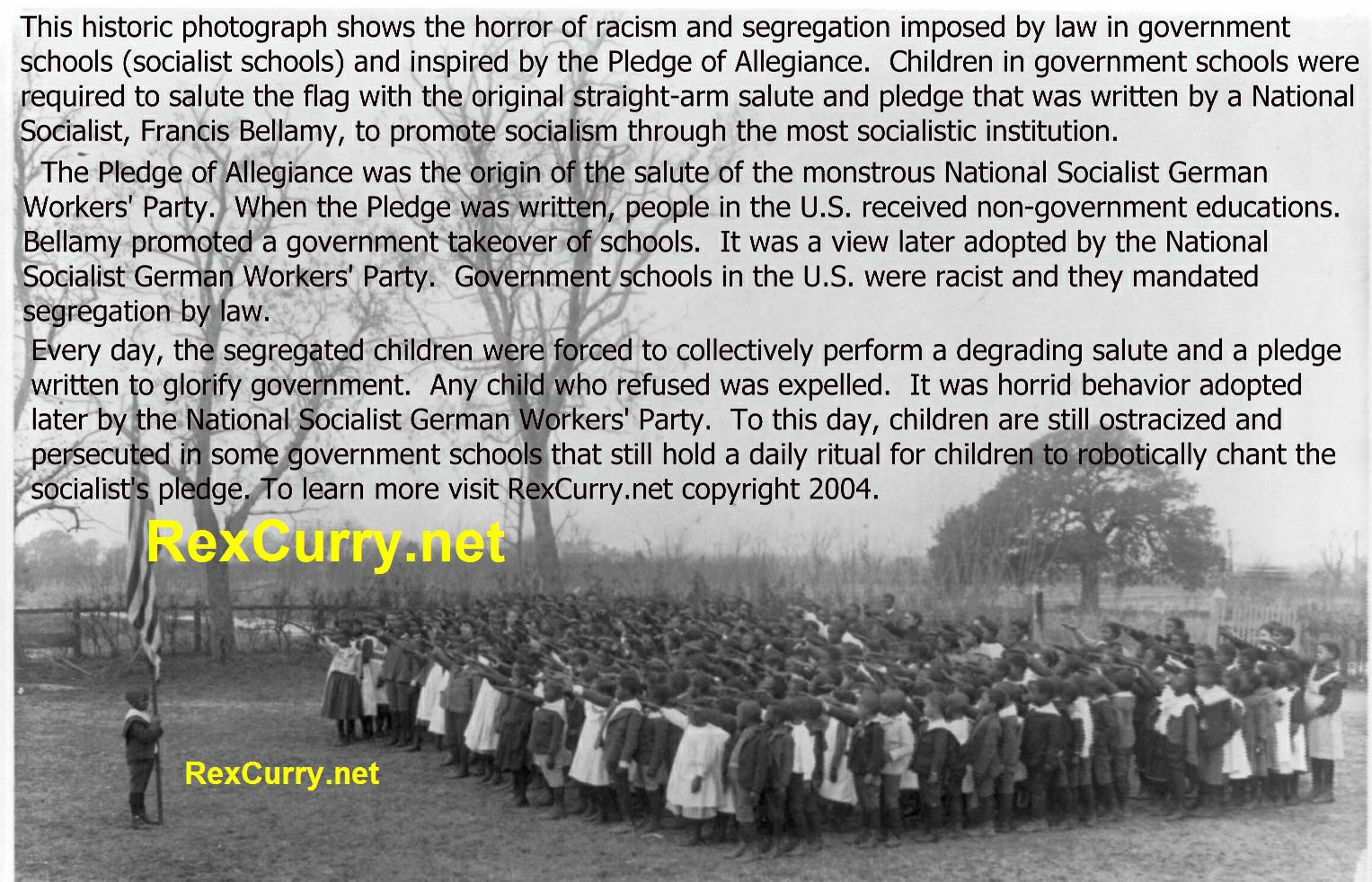
| Pledge of Allegiance controversy
over America's early Nazi salute. http://rexcurry.net/pledgenacdl.html Excerpts from New York Times March 9, 1937, Tuesday - SCHOOLS HERE TRY 'NAZI-TYPE' SALUTE; Row Raised Over New Pledge to Flag With Extended Arm--Principals Assail Idea A new type of flag salute, recommended by the State Department of Education and submitted to the principals through a circular issued by Harold G. Campbell, Superintendent of Schools, has brought confusion and uncertainty as to the proper method of pledging allegiance to the American flag, it was learned yesterday. In the traditional military salute the hand is raised to the head, at the proper time raised straight and then whipped briskly to the side. THE OLD AND NEW SCHOOLBOY SALUTE TO THE FLAG Students of Bryant High School in Queens demonstrating the change of posture as the Pledge of Allegiance is ... "We still have the traditional salute in the New York City schools," he said. ... "I can see no cause of alarm-this salute: does not try to copy Hitler's ... For a photograph of the early Pledge of Allegiance see http://rexcurry.net/pledge-allegiance-pledge-allegiance2.jpg **************** Army Salute for Children October 3, 1941, Friday New York Times ... use the regulation Army salute in the daily pledge of allegiance to the flag. ... the arm-extended salute because of its similarity to the Nazi greeting. ********************** The Syracuse Herald, Thursday, March 25, 1937 Rural School Choice OF Flag Salutes .. military fashion as the first words of pledge of allegiance are Although the ... salute is nothing either Nazi or Fascist about the suggested Mr Shingle ... http://rexcurry.net/pledge-of-allegiance1942fresno.pdf http://rexcurry.net/pledge-of-allegiance1941iowa-military.pdf http://rexcurry.net/pledge-of-allegiance1941jehovah-catholic.pdf http://rexcurry.net/pledge-of-allegiance1942lowell-mass.pdf http://rexcurry.net/pledge-of-allegiance1937syracuse-herald.pdf http://rexcurry.net/pledge-of-allegiance1937new-york.pdf |